Managing Modbus TCP definitions
Modbus TCP is a communication protocol typically used by facility or building level assets. Hyperview allows the creation of Modbus TCP definitions to handle the monitoring of such equipment separate from auto-discoveries.
A Modbus TCP definition can be assigned to any number of assets to enable monitoring on those assets if they share the same object mapping, but only one definition can be applied to an individual asset at a time. A single asset can be monitored across multiple Modbus device addresses using the same definition.
Modbus Register Addresses
Modbus TCP uses the 6-digit address length format to dictate register types and their address. Each register type is defined within a specific location and correlated address as per the table below.
Register Type |
Reference Range |
Prefix |
Full Address |
Access |
|---|---|---|---|---|
Coils |
00001 - 65536 |
0 |
000001 - 065536 |
Read Only |
Discrete Inputs |
00001 - 65536 |
1 |
100001 - 165536 |
Read Only |
Input Registers |
00001 - 65536 |
3 |
300001 - 365536 |
Read Only |
Holding Registers |
00001 - 65536 |
4 |
400001 - 465536 |
Read Only |
Hyperview allows you to enter the 5-digit reference range to the address, and will use the register type prefix to identify the full address.
Note
If an example Holding Register resides at address 421026, then it has a reference value of 21026 without the appended prefix.
While some register types are read/write, Hyperview is a read only system and does not perform write operations with Modbus TCP.
More information regarding the Modbus TCP protocol can be found in the following resources.
Tip
Hyperview uses a starting index of 0 for Modbus TCP addresses. If you are experiencing unexpected behavior with the sensor readings, then the register you are monitoring may have a starting index of 1. If this is the case, then you can increase the address in the Hyperview definition by 1 to validate the results.
Adding a Modbus TCP definition
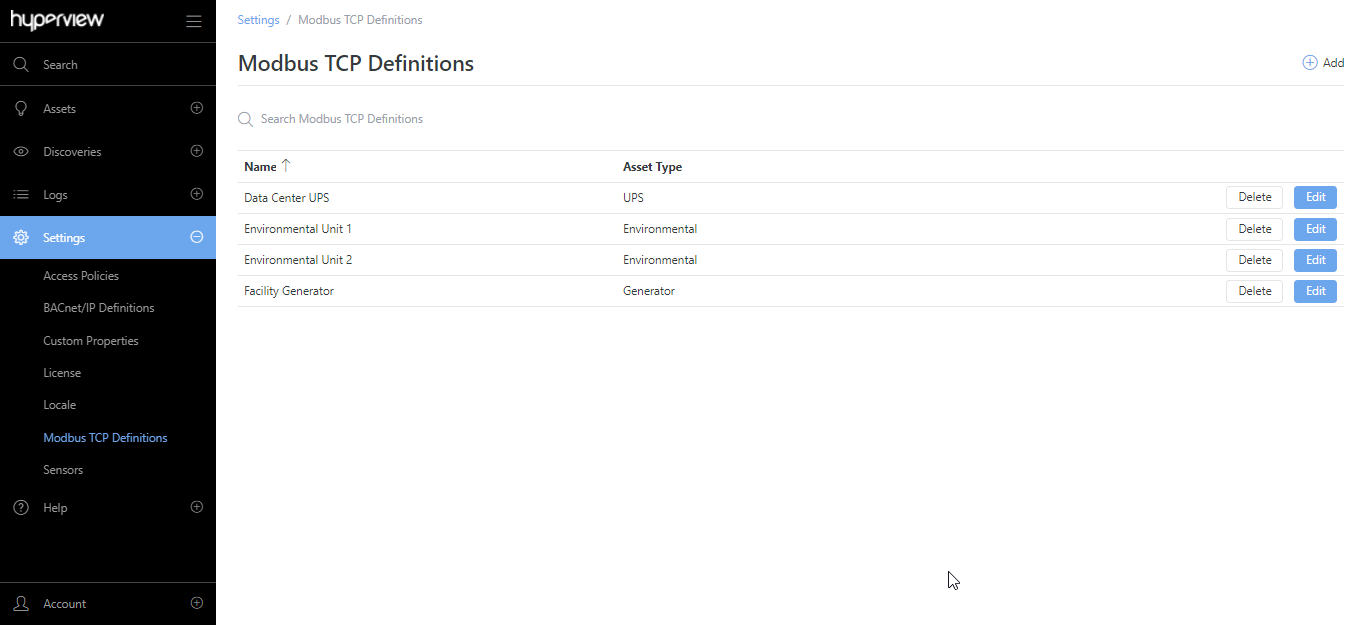
Go to Settings → Definitions → Modbus TCP Definitions.
Click Add. Alternatively, if you have no Modbus TCP definitions, click Add new Modbus TCP definition.
Enter a Name and Asset Type for the definition. You can optionally enter a Description. Click Save.
A success message will appear, and the Overview page of the new Modbus TCP definition will be displayed. Proceed to add sensor definitions.
Tip
Refer to the “Adding a single asset” section in Adding assets for steps to manually add assets with a Modbus TCP monitoring profile.
Adding components
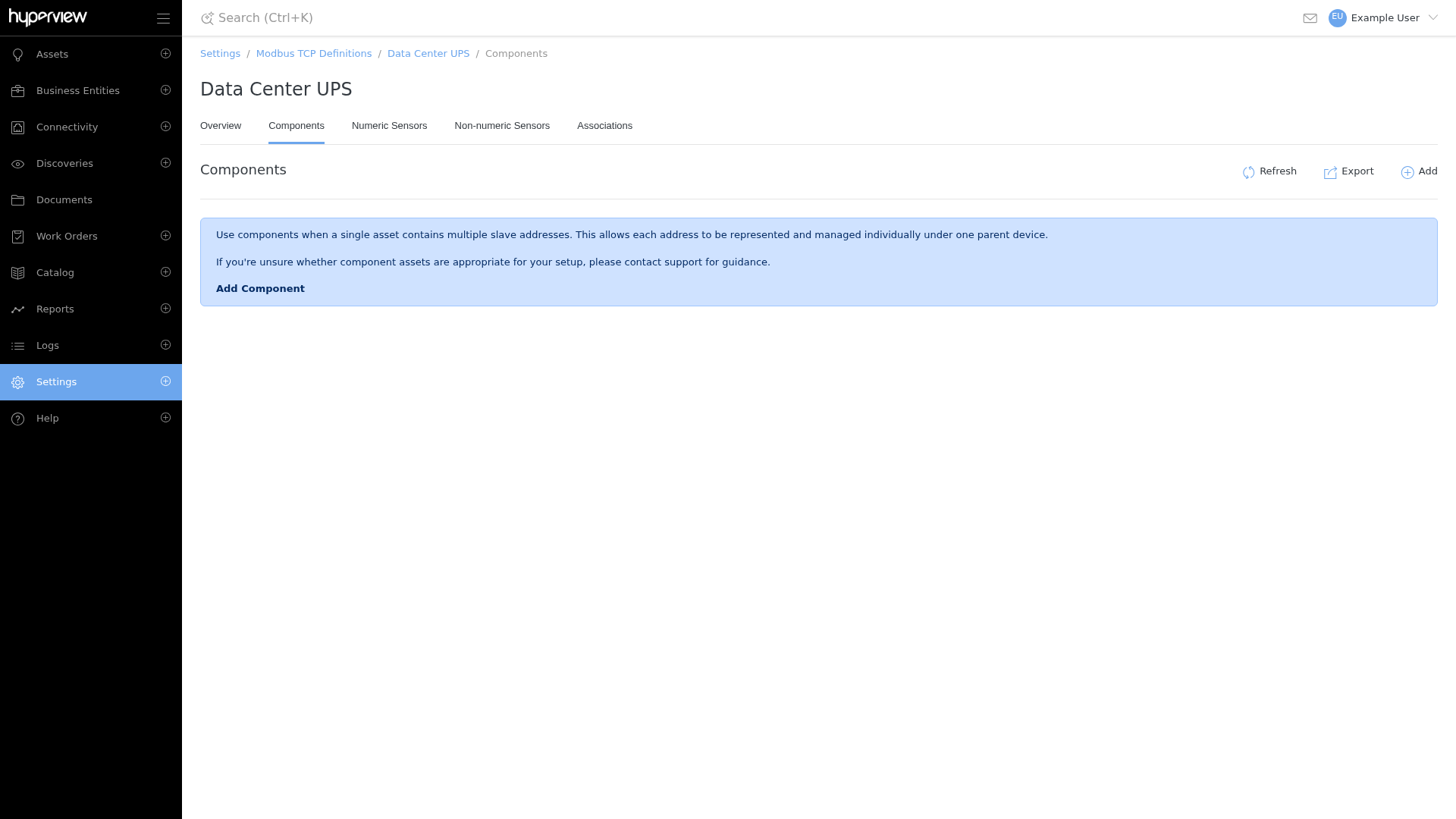
Use components when a single asset contains multiple Modbus device (slave) addresses. Each component represents one address and is managed individually under the parent device, so a single definition can cover all of the asset’s addresses.
While editing or adding the Modbus TCP definition, click the Components tab.
Click Add. Alternatively, if there are no existing components, click Add Component.
Enter a Component Name and click Save.
A success message will appear, and the component will be listed in the grid. Repeat the steps to add additional components as appropriate. When adding a numeric or non-numeric sensor definition, you can then assign the sensor to a component using the optional Component field.
Note
If you are unsure whether components are appropriate for your setup, contact Hyperview support for guidance.
Adding a numeric sensor definition
While editing or adding the Modbus TCP definition, click the Numeric Sensors tab.
Click Add. Alternatively, if there are no existing sensor definitions, click Add Numeric Sensor.
Provide values for Address, Type, Data Type, Sensor Type, Sensor Name, and Sensor Unit. Note that the Sensor Unit field will only appear once you have selected a Sensor Type. If the definition has components, you can optionally assign the sensor to a Component (see “Adding components” above).
Under Data Interpretation, choose the Order of Operations and provide a Multiplier and Offset to apply to raw values. A Formula Preview shows how the raw value will be transformed.
Click Save.
A success message will appear, and the numeric sensor definition will be listed in the grid. Repeat the steps to add additional sensor definitions as appropriate.
Adding a non-numeric sensor definition
While editing or adding the Modbus TCP definition, click the Non-numeric Sensors tab.
Click Add. Alternatively, if there are no existing sensor definitions, click Add Non-numeric Sensor.
Provide values for Address, Type, Sensor Type, Sensor Name. Additionally, you can modify Value mappings (for all types) or add Value mappings (for non-binary types). If the definition has components, you can optionally assign the sensor to a Component (see “Adding components” above).
Click Save.
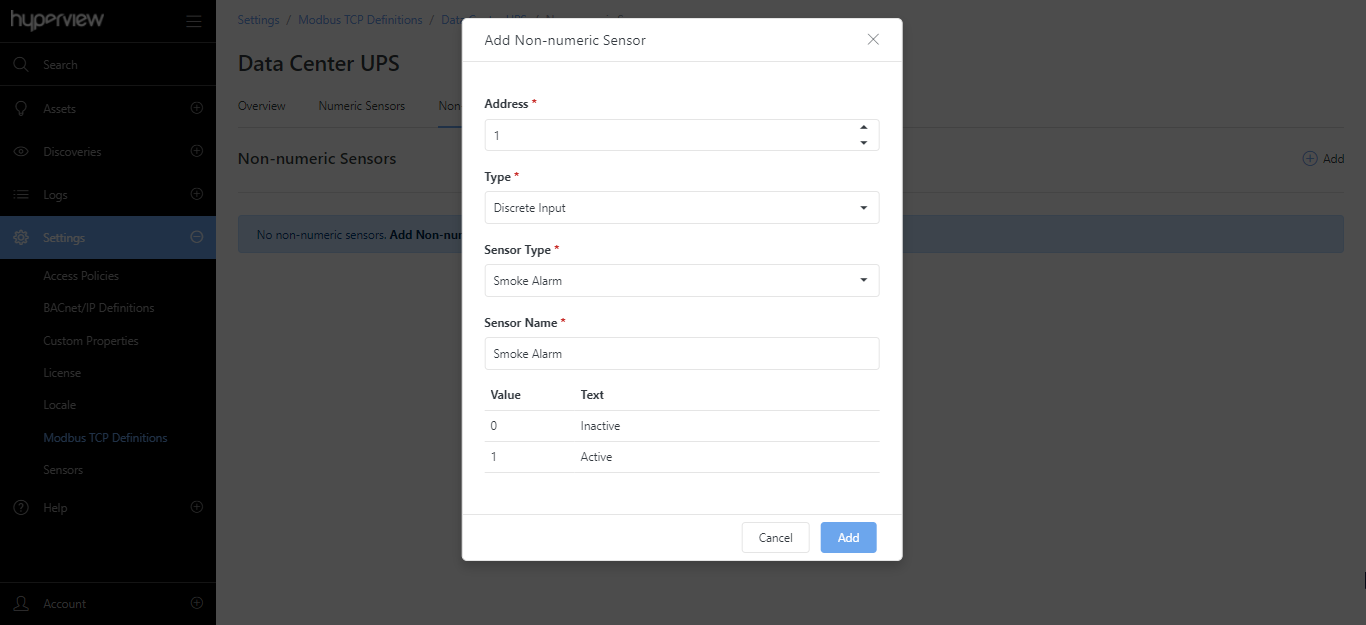
A success message will appear, and the non-numeric sensor definition will be listed in the grid. Repeat the steps to add additional sensor definitions as appropriate.
Updating a Modbus TCP definition
Go to Settings → Definitions → Modbus TCP Definitions → Edit.
Update values from the Overview or Numeric Sensors tab as required, and save your changes.
A success message will appear for each change, and the current page will reload to reflect the change.
Updating or deleting a sensor definition
While on the Numeric Sensors tab or the Non-numeric Sensors tab for a Modbus TCP definition:
Click Edit to update values for an existing sensor definition. Click Save to save the updated sensor definition.
Click Delete → Delete to delete an existing sensor definition.
A success message will appear in each case, and the current page will reload to reflect the change.
Deleting a Modbus TCP definition
You can see which assets use a definition on the definition’s Associations tab. You cannot delete a Modbus TCP definition that has associated assets. After you have updated associated assets (from each asset’s Information → Monitoring page):
Go to Settings → Definitions → Modbus TCP Definitions.
Click Delete → Delete for the intended definition.
A success message will appear, and the current page will reload to reflect the change.